
How to Find Bristol County Arrest Records
Arrest records in Bristol County are not held in a single public database. The Bristol County Sheriff's Office (BCSO) books people into county facilities, but no official public online jail roster has been published on BCSO's website. That means a custody check starts at the BCSO main switchboard at (508) 995-6400. Call with the person's full name, date of birth, and approximate arrest date if known. Staff can confirm custody status and point you to the right facility, either the Dartmouth Correctional Complex at 400 Faunce Corner Road, North Dartmouth, or the Ash Street Jail at 226 Ash Street, New Bedford.
For recent arrests that have reached the court stage, the Massachusetts Trial Court Electronic Case Access portal (MassCourts) is the best free public tool. Search by the person's name or by docket number. A criminal docket entry showing arraignment, bail, or a complaint filed can confirm that an arrest led to charges. MassCourts is not the official court record, but it does show public case status, court dates, and docket events.
VINELink is another official channel. Mass.gov directs users to VINELink for Massachusetts custody lookups. The service can notify you by phone or email when someone's custody status changes. For federal arrests, use the Bureau of Prisons inmate locator. Federal arrests go through the U.S. District Court for the District of Massachusetts, not Bristol County state courts.
The steps below give a practical search sequence.
- Call BCSO at (508) 995-6400 with the person's full name and date of birth to check county custody.
- Search MassCourts by name and select "District Court" or "Superior Court" to find any criminal docket for the arrest.
- Check VINELink for Massachusetts and register for custody notifications if you want ongoing updates.
- For state prison holds, follow the Mass.gov DOC guidance, which also routes to VINELink.
- For federal custody, use the BOP inmate locator.
For more on jail and booking details, see Bristol County inmate records.
Note: No official BCSO public roster exists online; always verify custody by calling (508) 995-6400 or using VINELink before acting on third-party data.
Arrest Record vs. Criminal Court Record
An arrest record and a criminal court record are different documents created by different offices at different times. An arrest record is made by the law enforcement agency that made the arrest. It documents the booking event: who was arrested, when, where, what charge was listed, and the booking number. A criminal court record is created by the court clerk after charges are formally filed. Court records track the legal case from arraignment through disposition, and they live in MassCourts or the physical court file at the Clerk-Magistrate's or Clerk of Courts' office.
An arrest can happen without charges ever being filed. Charges can be filed without a conviction. That chain matters when you use these records. Seeing someone's name in an arrest report does not mean they were convicted, or even that they faced trial. The Bristol County District Attorney's Office at 218 South Main Street, Suite 101, Fall River, (508) 997-0711, decides whether to prosecute following an arrest. If charges are dropped or the case is dismissed, the court record reflects that outcome, but the underlying arrest record may still exist unless the record is sealed or expunged.
| Arrest Record | Criminal Court Record | |
|---|---|---|
| Created by | Sheriff or police department at booking | Court Clerk or Clerk-Magistrate when charges are filed |
| Created when | At booking, after arrest | When the complaint or indictment is filed |
| Main contents | Booking number, name, date of arrest, charge listed, mugshot, facility | Docket events, bail, motions, hearings, verdict, sentence, probation |
| Where to search | BCSO switchboard (508) 995-6400; VINELink | MassCourts; Clerk's Office |
| Proves guilt? | No | Only if disposition shows guilty verdict or plea |
For full case history, including motions, hearings, and dispositions, see Bristol County court records. That page covers how to search MassCourts and how to obtain official copies from the Clerk of Courts or Clerk-Magistrate.
What Bristol County Arrest Records Show
Booking records contain a specific set of fields. Not every field is public. The standard information in an arrest record includes the person's full name, date of birth, booking number, date and time of arrest, arresting agency, charge or charges listed at the time of booking, bail status, facility assigned, and a booking photo (mugshot). Some agencies also record physical descriptors such as height, weight, hair color, and eye color.
What is not included is equally important. An arrest record does not show whether a charge led to a conviction. It does not show a sentence, probation terms, restitution orders, or case dismissals. Those details appear only in the court case record. Medical information collected during the booking medical screening is not public. Classification, housing assignment, and disciplinary records inside the jail are not public records. The Massachusetts Auditor's review of BCSO operations uses terminology such as booking number and release type (bail, death, parole, completion of sentence), which confirms the booking process creates a formal record, but the public-facing portion of that record is limited by law.
The CORI system is separate from both arrest records and court dockets. CORI stands for Criminal Offender Record Information, and it is governed by Massachusetts law under M.G.L. c. 6, §§ 167-178. The Mass.gov CORI guide explains who can access CORI, what it contains, and what restrictions apply. CORI can include charges, dispositions, and some sealed-record notations, depending on the requester's category.
Note: Booking information held by BCSO differs from CORI; CORI access levels depend on the requester's legal category under M.G.L. c. 6, § 172.
Charges vs. Convictions in Bristol County
A charge is an accusation. It means the Commonwealth or a police officer has alleged that a crime occurred and that the named person committed it. A charge appears in the arrest record at booking and in the court record after the complaint or indictment is filed. Being charged does not mean a person is guilty. Bristol County District Court handles many criminal complaints; Bristol County Superior Court in Taunton and Fall River handles major criminal matters and indictments. All Superior Court criminal matters are heard at the Taunton location (9 Court St.) and the Fall River location (186 S. Main St.); civil matters sit in New Bedford.
A conviction results from a guilty plea, a guilty verdict after trial, or an Alford plea. It means the court has found or accepted that the person committed the offense charged. The conviction and sentence appear in the court record, not in the booking record alone. Many arrests never become convictions. Cases get dismissed, nolle prossed, or result in not-guilty findings. The arrest record may still exist even if the case never resulted in a conviction, which is exactly why sealing and expungement matter for people whose cases ended favorably.
| Charge | Conviction | |
|---|---|---|
| What it means | An allegation that a crime was committed | A court finding or accepted plea of guilt |
| Legal standard | Probable cause (to arrest or charge) | Proof beyond a reasonable doubt |
| When it appears | At booking; when complaint is filed | After guilty plea, guilty verdict, or Alford plea |
| Public record? | Yes, in docket; subject to sealing/expungement | Yes, in court record; subject to sealing/expungement |
| Proves guilt? | No | Yes, as a legal matter |
Mugshots and Booking Photos
Booking photos, commonly called mugshots, are taken at the time of arrest and are part of the arrest record. In Massachusetts, booking photos are generally public records unless a specific exemption applies, such as records related to an ongoing investigation, a sealed case, or a juvenile matter. BCSO takes booking photos at both the Dartmouth Correctional Complex and the Ash Street Jail. There is no official BCSO public mugshot gallery online; requests for booking photos go through the BCSO main line or a formal public records request under M.G.L. c. 66, § 10.
Third-party mugshot websites republish booking photos from various sources. Massachusetts law does not specifically require those sites to remove photos, and photos may remain online even after a case is dismissed or a record is sealed. If a record is sealed under M.G.L. c. 276, § 100A or § 100C, the sealed status limits government and court access, but private websites are not bound by the same rules. People who want to address mugshot removal from commercial sites may need to pursue takedown requests directly or consult an attorney.
The Bristol County District Attorney's Office location page on Mass.gov confirms the DA serves all Bristol County cities and towns and can be reached at 218 South Main Street, Suite 101, Fall River. The image below shows that page.
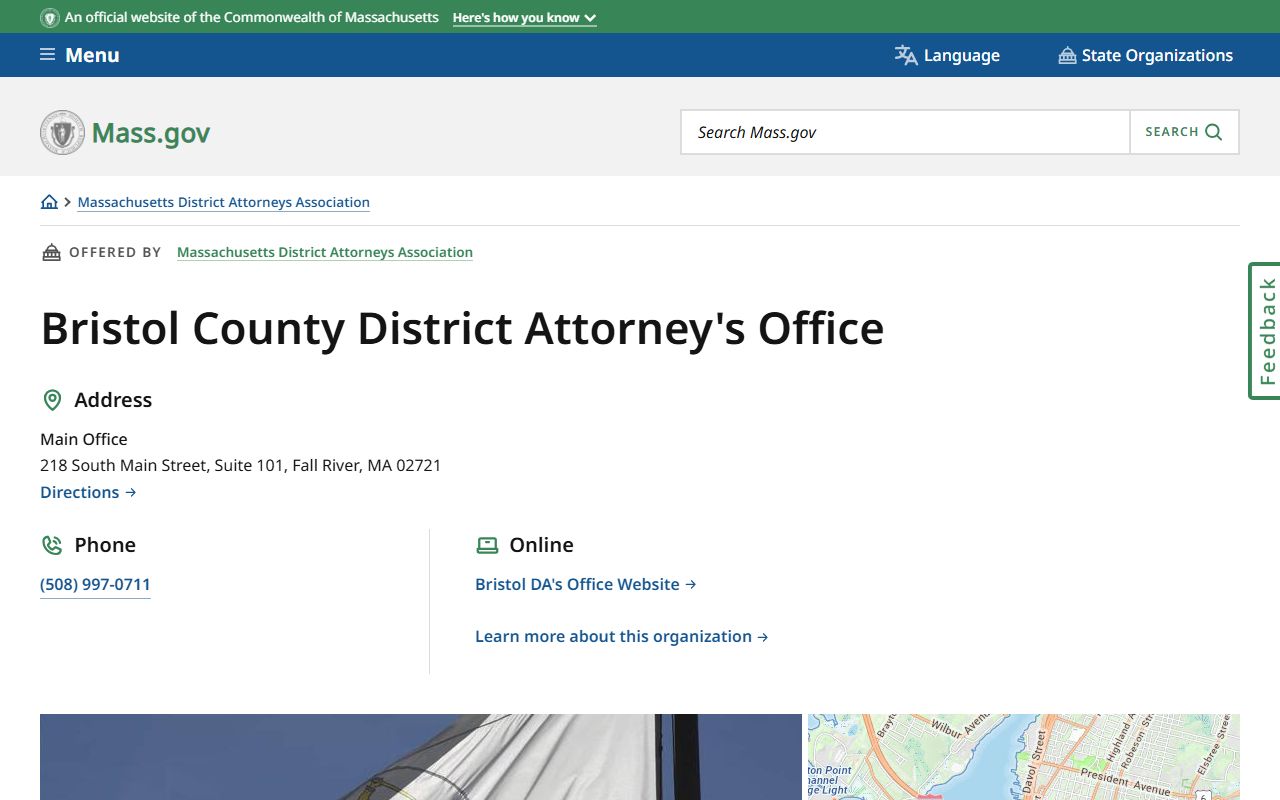
The DA's office reviews arrests and decides which cases to prosecute; a booking photo alone does not confirm that charges were filed or pursued.
Sealing Bristol County Arrest and Criminal Records
Massachusetts gives people two main tools for limiting public access to a criminal or arrest record: sealing and expungement. Sealing is more broadly available. It limits who can see the record. Expungement is narrower and, where it applies, removes the record more completely. Both processes are governed by statutes in M.G.L. c. 276.
M.G.L. c. 276, § 100A is the primary sealing statute. It allows a person to seal certain criminal appearances and dispositions after a waiting period. The waiting period depends on whether the record involves a conviction, an acquittal, a dismissal, or a nolle prosequi. Misdemeanor and felony conviction waiting periods differ. M.G.L. c. 276, § 100C covers sealing for certain outcomes like not-guilty findings, no probable-cause findings, and dismissals that may have shorter or no waiting periods. Both statutes are on the Massachusetts Legislature's official site.
The Mass.gov sealing eligibility tool walks through the waiting periods, offense categories, and conditions that must be met. The tool asks about the type of offense, the date of last disposition, and whether there are any other records that could affect eligibility. Bristol County residents file sealing requests at the court where the case originated, not at a county-wide office. That might be Fall River District Court, Taunton District Court, New Bedford District Court, Attleboro District Court, or a Bristol County Superior Court location, depending on where the original case was heard.
The Massachusetts Legislature's page for M.G.L. c. 276, § 100A is shown below, confirming the official text of the sealing statute.
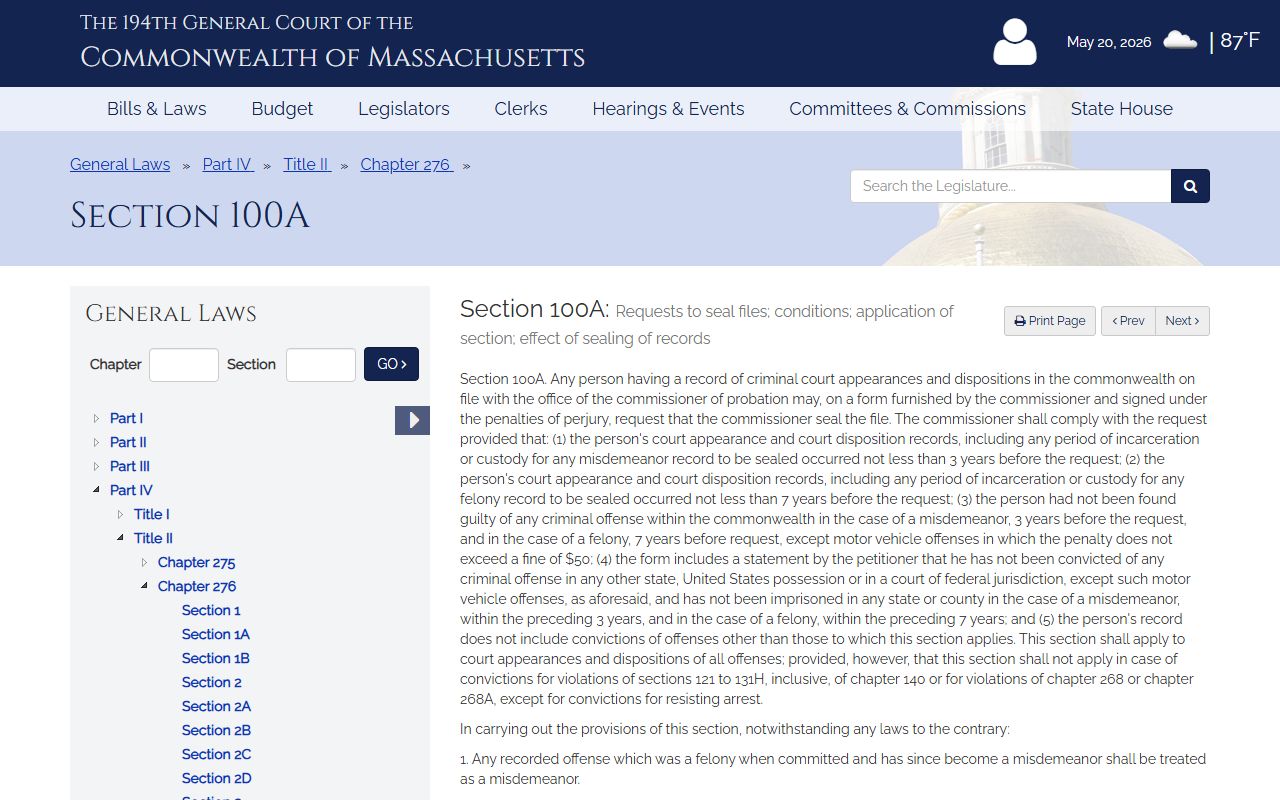
Reading the statute directly helps confirm current waiting periods and eligible record types before filing a sealing petition.
The related statute, M.G.L. c. 276, § 100C, addresses sealing for cases that ended without a conviction, including certain dismissals and not-guilty outcomes.
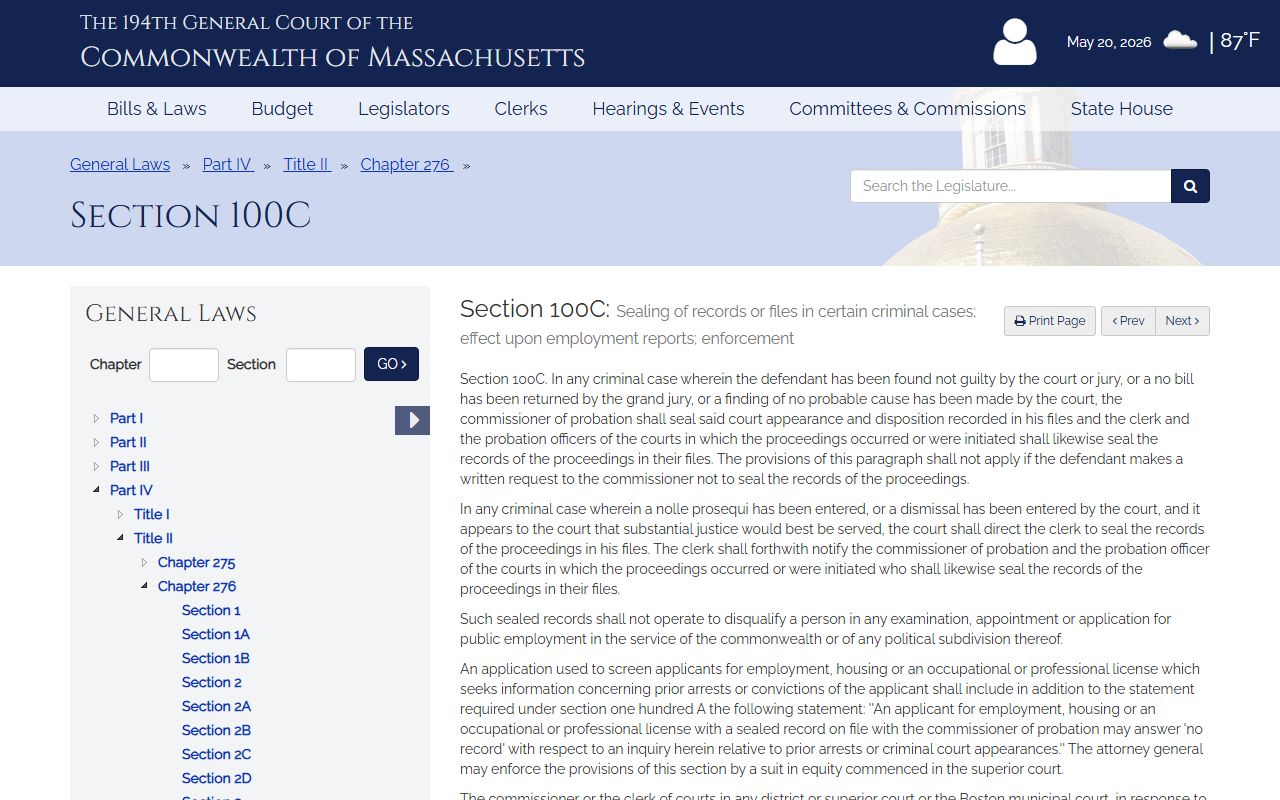
Cases that ended in dismissal or no probable-cause findings may be sealable under § 100C with different conditions than conviction-based sealing under § 100A.
The Mass.gov sealing eligibility page helps Bristol County residents check whether their specific record qualifies.
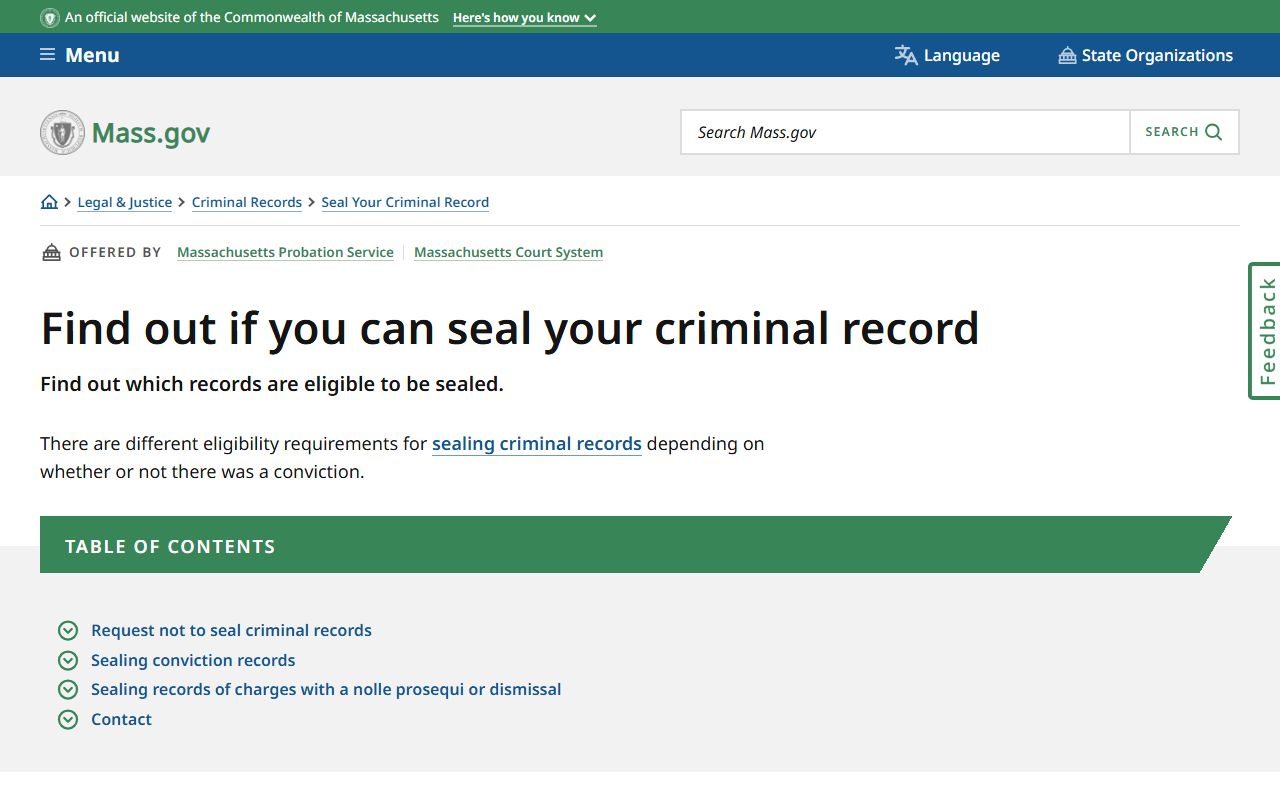
Using the eligibility tool before filing avoids wasting a petition on a record that is not yet eligible or does not qualify under the applicable statute.
Sealed vs. Expunged Records
Sealing and expungement are not the same thing, and Massachusetts law treats them differently. Both limit what the public can see, but they differ in scope, eligibility, and effect on the underlying record. Understanding the difference matters before deciding which process to pursue.
Expungement under M.G.L. c. 276, § 100F applies to records adjudicated delinquent or youthful offender. M.G.L. c. 276, § 100K covers expungement in specific situations: where a record resulted from use of false identification, where the underlying offense is no longer a crime, where the record resulted from error, or where fraud was involved. The grounds for expungement are more limited than those for sealing. People whose records do not fit a statutory expungement ground may still qualify for sealing. The Mass.gov CORI guide links to both processes and explains how sealed and expunged records interact with CORI access rules.
| Sealed Record | Expunged Record | |
|---|---|---|
| Effect on record | Hidden from public access; record still exists in restricted systems | Record removed or destroyed for eligible categories; treated as if it did not occur |
| Public visibility | Not shown in standard public searches | Not shown; generally not disclosed even when asked |
| Law enforcement access | Available for limited law-enforcement, court, and sentencing purposes under § 100A | Very limited; statutory language governs permitted uses |
| MA statutory basis | M.G.L. c. 276, §§ 100A, 100C | M.G.L. c. 276, §§ 100F, 100K |
| Who can apply | Most people with eligible criminal appearances after waiting period | People with qualifying youthful-offender records, false-ID cases, decriminalized offenses, errors, or fraud |
| Where to file | Court where the case was heard in Bristol County | Court where the case was heard in Bristol County |
Juvenile Arrest Records in Bristol County
Juvenile records are treated very differently from adult records. M.G.L. c. 119, § 60A restricts delinquency court records from public inspection. The statute allows access only with the consent of a justice and permits the juvenile, parents, guardian, or attorney to inspect at reasonable times. That means a juvenile's arrest and court records are generally not available through the public MassCourts search and are not public records in the way that adult criminal records are.
Bristol County Juvenile Court has four locations: Attleboro at 88 North Main St., Fall River at 289 Rock St. 4th Floor, New Bedford at 75 N. Sixth St., and Taunton at 40 Broadway. All four locations handle delinquency, youthful offender, care and protection, and child requiring assistance matters. Because juvenile records are restricted, people seeking access to a specific juvenile file should consult with an attorney or contact the Juvenile Court Clerk-Magistrate directly at the location that handled the case. Juvenile specialty court programs, including Juvenile Drug Courts operating in New Bedford, Fall River, and Taunton/Attleboro, also involve restricted records.
Expungement under § 100F may be available for some juvenile delinquency and youthful offender records, which provides an additional layer of relief beyond the statutory access restrictions already in place under c. 119, § 60A.
The juvenile record access statute is shown on the Massachusetts Legislature's site.
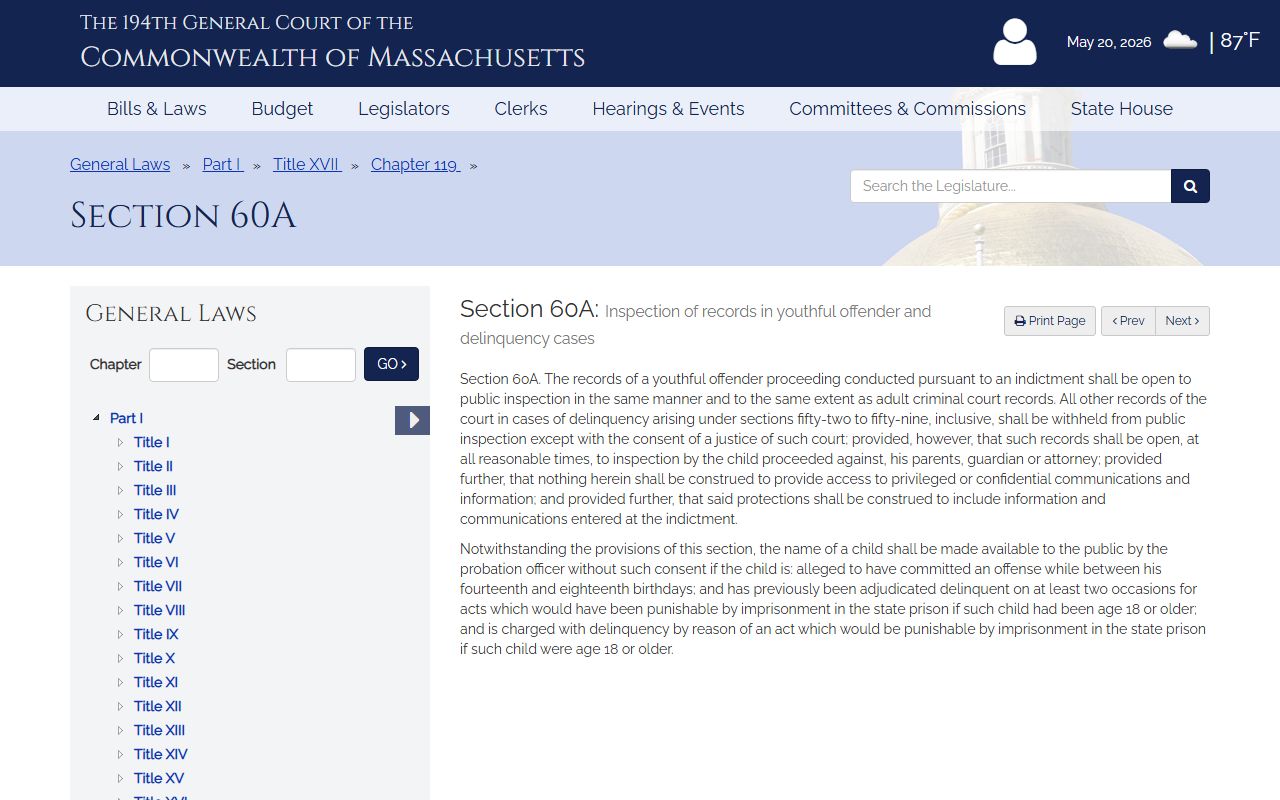
The statute is the governing authority on who may access Bristol County juvenile court records and under what conditions.
Sex Offender Registry and Bristol County Records
The Massachusetts Sex Offender Registry Board (SORB) maintains a separate public registry for registered sex offenders. SORB records are not the same as arrest records or criminal court records, but the underlying convictions that trigger registration are part of a person's criminal history. The SORB public information page explains how to search for sex offenders by town, address, or name. The level of public information varies by the offender's classification level, with Level 3 (high-risk) offenders subject to community notification and Level 1 offenders generally not publicly listed. An official SORB sex offender inquiry form is also available for formal information requests.
Bristol County has registered sex offenders in all major cities and towns. The SORB search allows geographic lookups by ZIP code, city, town, or county. Information from the registry should be used as the statute allows; M.G.L. c. 6, §§ 178C-178Q governs registration and prohibits misuse of registry information. Using registry data to harass or threaten a registrant is a criminal offense under Massachusetts law.
Note: SORB registration level determines public visibility; contact SORB directly for questions about a specific offender's classification or registration status.
Criminal Court Records in Bristol County
Criminal court records cover the full case from arraignment to disposition. They sit in the court that handled the charge. Bristol County Superior Court hears major criminal matters and felony indictments. The Taunton location at 9 Court St. and the Fall River location at 186 S. Main St. handle criminal Superior Court cases. District Courts in Attleboro, Fall River, New Bedford, and Taunton handle many lower-level criminal matters, including misdemeanors and certain felony proceedings, as well as local arraignments. Clerk-Magistrates at each District Court location are the correct contacts for copies of District Court criminal case files.
For criminal matters that resulted in an indictment, the Bristol County Superior Court Clerk of Courts, Jennifer Sullivan, maintains those records. The Clerk of Courts office phone for the Taunton Superior Court is (508) 823-6588. Official criminal court records and hard copies are obtained from the office where the case was filed, not from MassCourts alone. MassCourts provides docket information online but is not a substitute for the official record. Active warrants and bench warrants that appear in criminal dockets are covered in more detail on the Bristol County warrant records page.
For full coverage of how to search criminal and civil court dockets, what fields appear in case records, and how to get official copies, see Bristol County court records.
Background Checks and CORI in Massachusetts
Background checks in Massachusetts often involve CORI, Criminal Offender Record Information. CORI is governed by M.G.L. c. 6, §§ 167-178 and is a separate system from public court dockets. Employers, landlords, and other authorized requesters can access CORI through the state's online CORI system. What they see depends on their requester category and on whether any records have been sealed or expunged. The Mass.gov CORI guide explains requester categories, what each level can see, how to request your own CORI, and how to challenge errors in a CORI report.
A public search of MassCourts shows docket information but is not the same as a CORI check. MassCourts is open to anyone and does not require authorization. CORI access is regulated and varies by requester type. Standard employers see a narrower CORI than criminal-justice agencies do. Sealed records, in most circumstances, do not appear in CORI checks that employers or landlords conduct under the standard access rules, which is one reason why sealing matters even for people whose cases are long-closed.
For people with prior records, the Bristol Law Library at 9 Court St., Taunton, offers free Westlaw and Lexis access and can help with legal research on sealing eligibility. The Committee for Public Counsel Services (CPCS) provides representation for eligible people in criminal and other qualifying matters. Traffic-related criminal charges, including OUI, overlap with both criminal court records and traffic citations; see Bristol County traffic court records for that overlap.
Important: Bristol County Court Records is not an FCRA-regulated consumer reporting agency; do not use it for employment, credit, housing, insurance, or other FCRA-covered purposes.