
How to Search Bristol County Probate Records
Bristol County probate case information is available online through the MassCourts Trial Court Electronic Case Access portal. The portal is free and does not require an account for basic docket searches. It shows case numbers, party names, filing dates, case type, status, and scheduled hearing dates. It does not replace the official court record. For official copies of wills, decrees, accounts, or orders, you need to contact the Register's Office at the Bristol Probate and Family Court location where the case was filed.
Mass.gov's docket-search guidance is clear on this point: online case information is not the official public record. Hard copies and certified documents come from the Clerk or Register's office. For probate matters, that means contacting one of the three Bristol Register's Office locations by phone, in person, or by mail with the docket number and a description of what you need.
Older probate records may be held in Trial Court archives. Ask the Register's Office whether the case you are looking for has been transferred, and follow their guidance on how to request archived materials.
- Identify the subject: decedent's name for an estate case, or the name of the ward or protected person for a guardianship or conservatorship matter.
- Open the MassCourts portal. Select "Probate and Family Court" as the court department and choose a Bristol County location (Taunton, Fall River, or New Bedford). Search by the party name.
- Note the docket number, case caption, and filing date from the result list.
- Review the public docket entries for estate status, hearing dates, and any appointments or decrees listed.
- Contact the Register's Office at the location where the case was filed. Provide the docket number, party name, and the documents you need.
- For estates, ask whether a will, petition, inventory, account, or decree of distribution is on file. For guardianships or conservatorships, expect some financial and medical documents to be restricted.
Note: The MassCourts portal requires browser JavaScript and may not render on older devices; use a current browser for the best results.
What Bristol County Probate Records Cover
The Bristol Probate and Family Court handles a wide range of matters. Estate and family cases both fall within this court's jurisdiction, which is why the same Register's Office keeps records for wills and for divorce. The range of record types is broader than most people expect when they first need to look something up.
Probate record types at the Bristol Probate and Family Court include:
- Wills and petitions for formal or informal probate
- Estate administration, appointment of personal representative, inventory, account, and decree of distribution
- License to sell real estate as part of an estate
- Guardianship of minors and adults
- Conservatorship and protected-person property management
- Trust matters
- Name changes
Family matters handled by the same court include divorce, legal separation, child support, custody, paternity, and adoption-related proceedings. These records are maintained by the same Register's Office but follow separate access rules. Some family-case documents, especially financial statements and child-related materials, may be impounded or restricted. For more on divorce and marriage records, see the marriage and divorce records page.
The Bristol Probate and Family Court Taunton location page on Mass.gov provides the official list of services, Register's Office contact details, and links to court forms.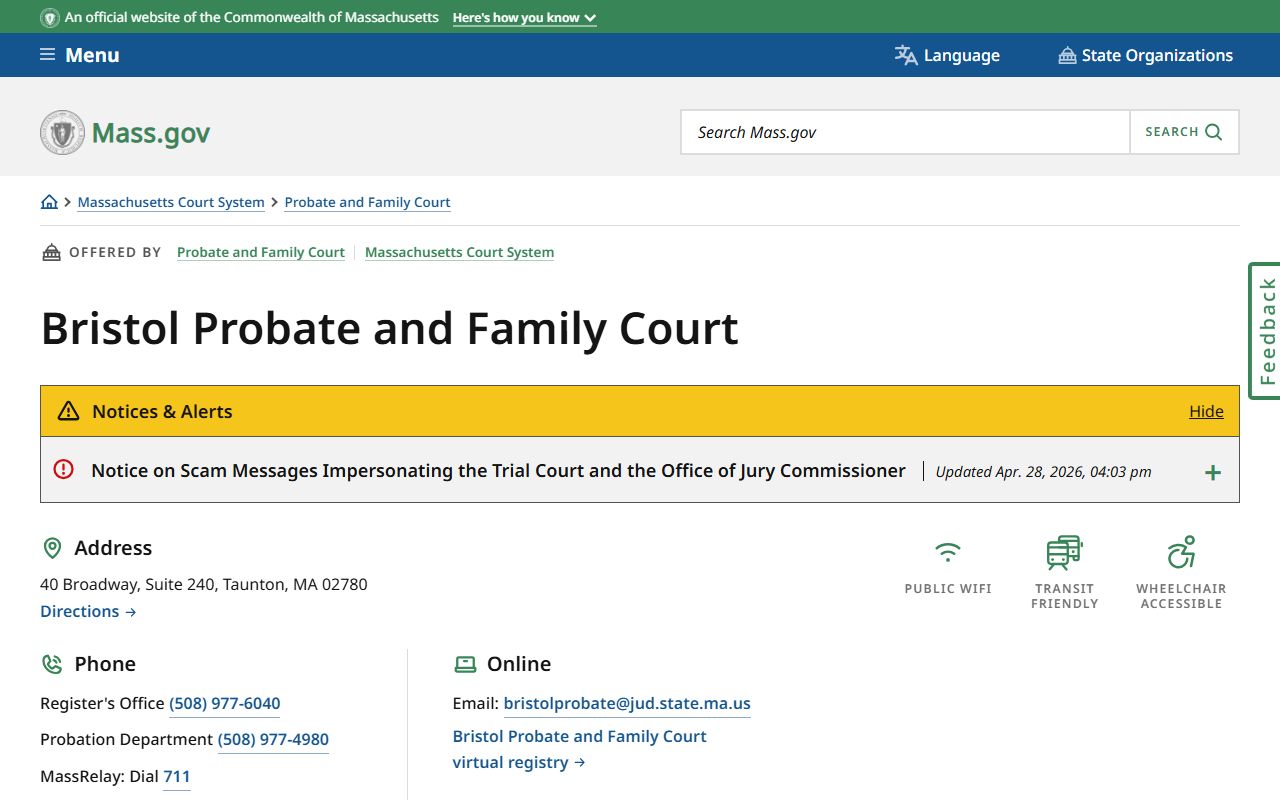 The Taunton location at 40 Broadway houses both the Register's Office and the Probation Department for the Bristol Probate and Family Court, and it serves all Bristol County cities and towns.
Bristol Probate and Family Court Locations
The Bristol Probate and Family Court operates at three locations across the county. All three serve the full range of Bristol County cities and towns, so you can file or pick up records at the location most convenient to you. Register Thomas C. Hoye, Jr. oversees all three locations. First Justice Hon. Paul M. Cronan sits in Taunton; First Justice Hon. Katherine A. Field sits in Fall River and New Bedford.
Bristol Probate and Family Court - Taunton
40 Broadway, Suite 240
Taunton, MA 02780
Register's Office: (508) 977-6040
Fax: (508) 977-6088
Email: bristolprobate@jud.state.ma.us
Hours: Monday-Friday 8:30 am - 4:30 pm
Bristol Probate and Family Court - Fall River
289 Rock Street
Fall River, MA 02720
Register's Office & Probation: (508) 672-1751
Fax: (508) 673-7068
Hours: Monday-Friday 8:30 am - 4:30 pm
Bristol Probate and Family Court - New Bedford
505 Pleasant Street
New Bedford, MA 02740
Register's Office & Probation: (508) 999-5249
Register Fax: (508) 999-1211
Hours: Monday, Tuesday, Thursday, Friday 8:30 am - 4:30 pm
The Taunton location also offers a Virtual Registry for remote help with registry questions. The Bristol Probate and Family Court Virtual Registry operates Monday through Friday, 9:00 am to 12:00 pm and 2:00 pm to 4:00 pm, by Zoom. A phone dial-in option is also listed on the Mass.gov page. Registry staff can help with procedural questions but cannot give legal advice.
New Bedford's hours differ from the other two locations. The New Bedford Register's Office is closed on Wednesdays. Confirm hours before visiting, especially around holidays.
The Fall River Probate and Family Court location page includes information on parking, SRTA bus access, and public Wi-Fi at the 289 Rock Street building.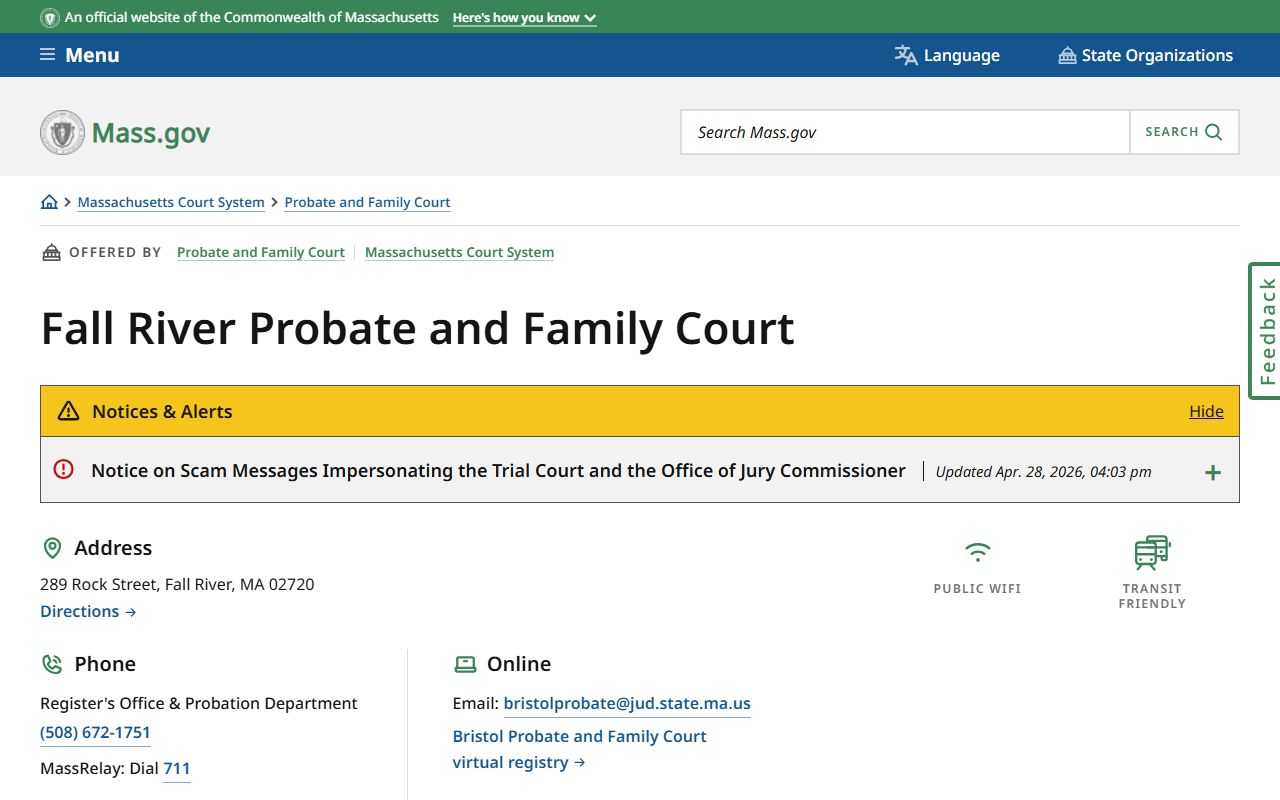 The Fall River location shares the Rock Street building with Fall River Juvenile Court and Southeast Housing Court, making it a multi-court hub for the southern part of Bristol County.
Searching Probate Cases on MassCourts
The MassCourts portal supports both name-based and docket-number searches. For probate matters, searching by the decedent's name or the ward's name usually works well if you don't already have the docket number. The table below shows the key fields available when searching Probate and Family Court cases.
| Field | Type | Notes |
|---|---|---|
| Search Mode | Tab selection | Switch between name search and case/docket number search |
| Court Department | Dropdown | Select "Probate and Family Court" to narrow results to Bristol locations |
| Court Division / Location | Dropdown | Choose Taunton, Fall River, or New Bedford |
| Last Name / Organization | Text | Decedent, petitioner, or respondent last name |
| First Name | Text | Optional; narrows search when common last names appear |
| Docket / Case Number | Text | Use full docket number from court paperwork when known |
| Case Type | Dropdown | Probate estate, guardianship, conservatorship, divorce, and others |
| Date Range | Date fields | Optional; useful for narrowing by filing year |
Public docket results typically show the docket number, party names, filing date, case type, and current status. Docket entries list events such as petition filed, appointment of personal representative, notice to creditors, inventory filed, account allowed, and decree entered. Full documents are generally not available remotely to the general public under Uniform Rule 5. You need to contact the Register's Office for certified copies of wills, decrees, inventories, and other court documents.
The New Bedford Probate and Family Court location page on Mass.gov provides the Register's Office phone, fax, and operating days for the Pleasant Street location.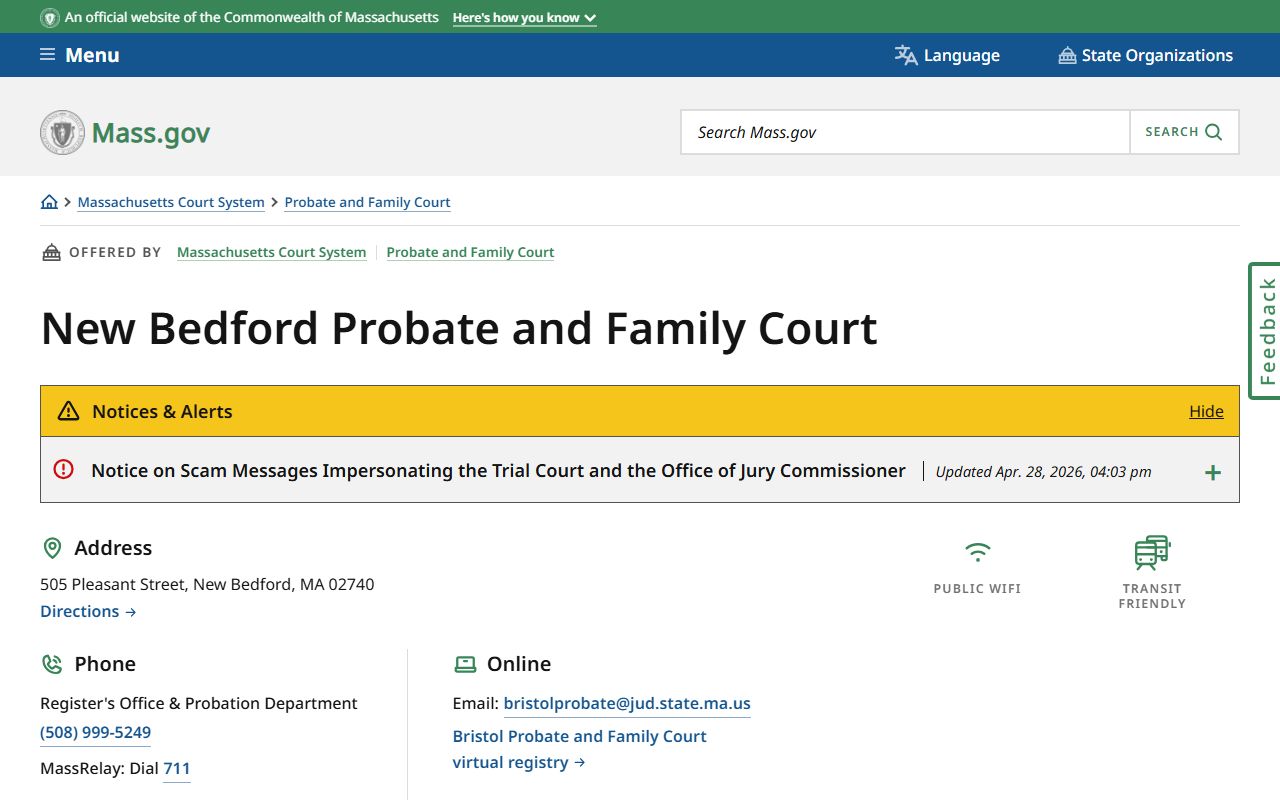 New Bedford's location at 505 Pleasant Street is near SRTA bus routes and public parking garages, which can make in-person record requests more manageable for residents in the southern part of the county.
Probate Terms Defined
Probate filings use legal terms that can seem confusing at first. Knowing the basics helps when you are reading a docket or asking the Register's Office for a specific document. The definitions below reflect how these terms are used in Massachusetts Probate and Family Court proceedings.
- Testator
- The person who made a will. When someone dies and leaves a written will, the law calls that person the testator. The will names an executor and sets out how the testator's property should pass.
- Executor / Personal Representative
- The person or institution named in a will or appointed by the court to carry out the estate. In Massachusetts, the current term in the Uniform Probate Code is "personal representative," though "executor" is still widely used. The personal representative collects assets, pays debts, and distributes the estate to heirs and beneficiaries.
- Intestate
- Dying without a valid will. When a person dies intestate, Massachusetts law determines how the estate is distributed among surviving relatives. The court appoints an administrator to manage the estate, which functions much like an executor.
- Guardianship
- A court-ordered arrangement giving one person or entity legal authority over another person who cannot manage their own personal decisions. Guardianship can apply to minors without a parent able to care for them, or to adults who are found to lack the capacity to make personal decisions. The guardian does not automatically manage finances.
- Conservatorship
- A court-ordered arrangement for managing the financial affairs of a person who is unable to do so themselves, often called a "protected person." A conservator handles assets, pays bills, and files accounts with the court. Medical records and financial documents in conservatorship cases may be restricted or impounded.
Note: Massachusetts uses the Uniform Probate Code, so some terminology may differ from what you see in older Massachusetts estate documents or in resources written for other states.
Estate Administration Records in Bristol County
When a person dies with assets that need formal transfer, their estate goes through the Bristol Probate and Family Court. The process can be informal or formal depending on the circumstances. Formal probate generates a more complete paper trail of court filings, hearings, and decrees. Informal probate is streamlined but still produces official docket entries that are searchable in MassCourts.
An estate file typically contains several layers of documents. The petition for probate comes first, followed by appointment of the personal representative, notice to creditors, inventory of assets, accounting of income and expenses, and finally a decree of distribution. Each step generates a docket entry. If the estate is contested, there may be additional motion practice, hearings, and orders. The court file can grow large in complex or disputed estates, and some portions of the file may be sealed if a justice orders it.
Copies of estate records are obtained from the Register's Office at the court where the petition was filed. For recent cases, call ahead with the docket number. For older cases, ask about Trial Court archives. There is no charge for viewing documents at the Register's Office, but fees apply for certified copies. The court's official fee schedule is posted on the Bristol Probate and Family Court location pages on Mass.gov; do not rely on third-party sources for current fee amounts.
The court also handles estates for decedents who owned real property in Bristol County but lived elsewhere. If the decedent had land in multiple counties, ancillary probate proceedings may be needed in each county where property is located.
Guardianship and Conservatorship Records
Guardianship and conservatorship cases are filed in the same Bristol Probate and Family Court locations as estate cases. They are separate case types, and the public access rules are somewhat stricter because these files often contain medical evaluations, financial accounts, and information about vulnerable people.
A guardianship petition for a minor is typically filed when a child has no living parent able to care for them, or when a parent's rights have been terminated or suspended. Guardianship of an adult is filed when someone is found to lack capacity to make personal decisions. An adult guardianship file may include a medical certificate or clinical team report, which the court may impound to protect privacy. The docket entry will still be visible in MassCourts, but the medical document itself may not be publicly accessible.
Conservatorship files for adults with financial capacity issues often contain inventories and annual accounts showing the protected person's assets and expenditures. The court reviews these accounts. Some financial details may be impounded. Interested parties, including family members and the protected person, generally have the right to review the file, but public access to medical and financial details is more limited than in a standard estate case.
If you need information from a guardianship or conservatorship file, call the Register's Office first and explain what you are looking for. The staff can tell you what is publicly accessible and what requires a court order or a showing of interest. For court records involving other Bristol County proceedings, the same general rule applies: the Register or Clerk's office where the case was filed is the right starting point.
Bristol County Probate Filing Fees
The Bristol Probate and Family Court charges filing fees set by the Massachusetts Trial Court. Fee amounts were not captured in the research for this county and should not be estimated. The official filing fee schedule is available on the Mass.gov Probate and Family Court pages. Fees vary by filing type: petitions for formal probate, guardianship petitions, conservatorship petitions, name changes, and certified copies each carry different amounts.
To get current fee information, check the links on the Bristol Probate and Family Court Taunton page, which includes a link to the Probate and Family Court filing-fee schedule maintained by the Massachusetts Trial Court. You can also call the Register's Office at any of the three Bristol locations to ask about the fee for a specific filing type before you come in. Payment methods accepted at the courthouse may include cash, check, or money order; confirm accepted methods when you call.
Certified copies of probate documents, such as a will or a decree of appointment, carry a per-page fee. Plain (uncertified) copies cost less. For legal proceedings, such as transferring real estate from an estate, you will need a certified copy. Ask the Register's Office which documents require certification for your specific purpose.
Impounded Probate Records and Corrections
Not every document in a Bristol County probate case is open to the public. Some records are impounded by statute, court rule, standing order, or a judge's decision in a specific case. Common reasons for impoundment in Probate and Family Court include protecting minor children's identifying information, shielding medical evaluations in guardianship cases, restricting financial account details in conservatorship files, and preventing public access to abuse prevention or sensitive family-law materials.
When a record is impounded, the docket entry may still appear in MassCourts, but the underlying document is not available without a court order. An attorney for a party in the case can request access through the court. Members of the general public who believe they have a legitimate interest in an impounded document should consult legal counsel before seeking court review.
If you find an error in the online case information, the Probate and Family Court FAQ on public court record access says a Request for Correction of Clerical Error can be filed with the court where the case is located. This process corrects data-entry mistakes in the docket, not substantive errors in court orders or decrees. For a substantive error in a decree or order, you would need to file a motion to correct or amend with the court.
The Probate and Family Court FAQ page on Mass.gov addresses online case information access, what records are public, impoundment rules, and how to request corrections. The FAQ is the official source for how the Massachusetts Probate and Family Court handles public access questions, and it should be your first stop if you are unsure whether a particular record type is available online or requires an in-person visit.
Note: Sealed, impounded, and adoption-related records are subject to different access rules than ordinary estate or guardianship files; when in doubt, call the Register's Office before making a trip to the courthouse.