
Bristol County Public Records and the Law
Massachusetts public-records access rests on M.G.L. c. 66, §10, which gives any person the right to inspect or copy records made or received by a state agency or municipality. The statute creates a strong presumption in favor of disclosure. If a record exists and no exemption applies, the agency must let you see it. The law covers both paper and electronic records, photographs, maps, data compilations, and other materials regardless of physical form. Anyone can make a request. You do not need to explain why you want the records, and you do not need to be a Massachusetts resident.
Exemptions to disclosure are listed in M.G.L. c. 4, §7, clause 26. That statute identifies categories of information an agency may withhold, including personal privacy materials, investigatory records that could harm an ongoing case, personnel and medical files, trade secrets, security-related information, and certain attorney communications. An agency claiming an exemption must explain which category applies. Not every sensitive document is automatically exempt; the agency carries the burden of showing that releasing the record would cause the harm the exemption is meant to prevent.
The regulations at 950 CMR 32.00 flesh out the procedural details, including how agencies must log requests, calculate fees, and respond in writing. The Secretary of the Commonwealth's Public Records Division publishes guidance, model request templates, and contact information for the Supervisor of Records, who handles appeals. That guidance is the clearest official starting point for anyone filing a Bristol County public records request for the first time.
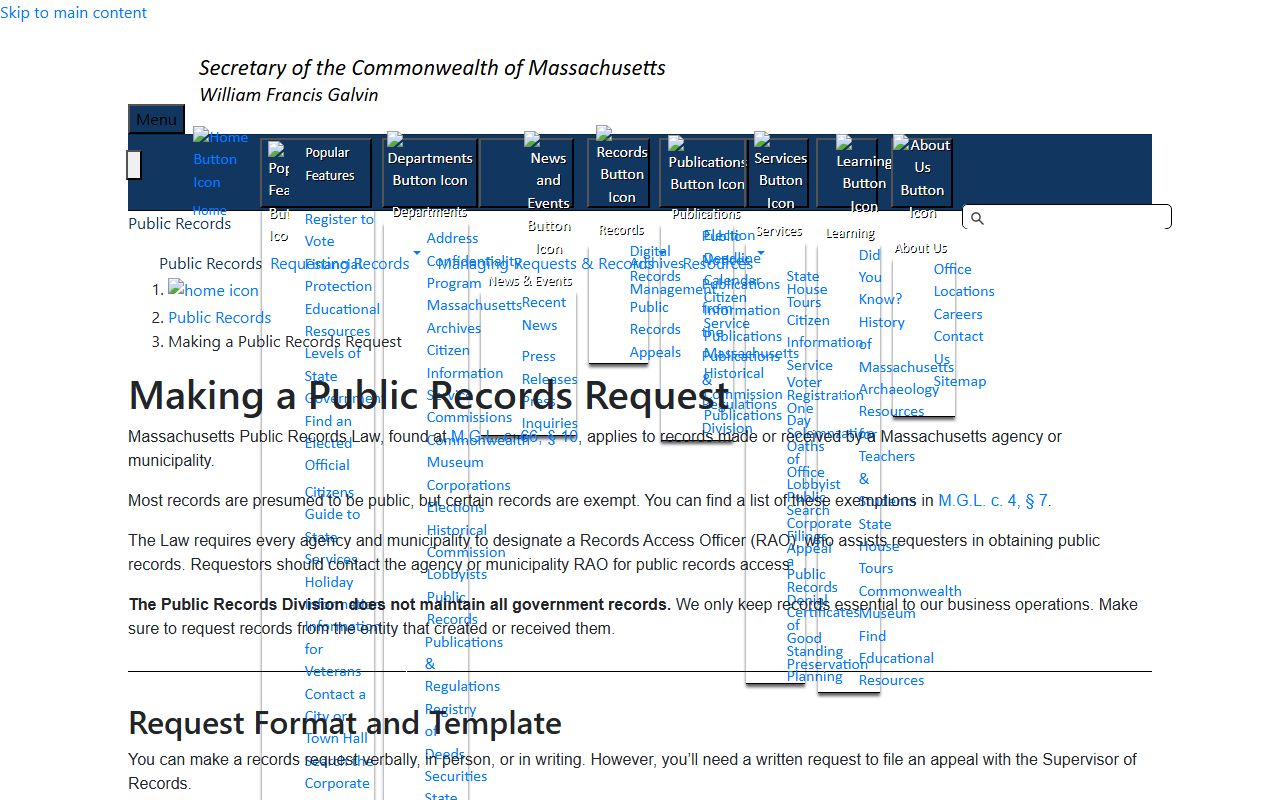
The Secretary of the Commonwealth's public-records page explains how to draft a request, where to send it, and what to do when an agency does not respond in time.
Public Records Law vs Court Record Rules
One of the most common points of confusion for Bristol County residents involves the difference between a public-records-law request and a request for court records. The two systems are separate. The Massachusetts Public Records Law applies to executive-branch agencies and municipalities. It does not govern the judiciary. Court records held by Trial Court departments follow the Trial Court's own Uniform Rules on Public Access to Court Records, not M.G.L. c. 66, §10.
What this means in practice: if you want a copy of a divorce judgment, a criminal docket entry, a civil complaint, or any other document filed in a Bristol County court, you go to the clerk or register office where the case was filed. You do not send a public-records-law request to the court. The MassCourts Electronic Case Access portal lets you look up basic docket information online, but Mass.gov makes clear that official hard copies come from the Clerk, Register, or Recorder's office where the case sits. See the Clerk of Courts page for contact details for each Bristol County court office, or the court records page for a full walkthrough of the docket-search process.
Land records are another separate category. Deeds, mortgages, homestead declarations, and similar property documents are Registry of Deeds records, not court records and not ordinary agency public records. The Northern Bristol County Registry of Deeds in Taunton handles land records for a large portion of the county. Those documents are public and can be viewed at the Registry at no charge during recording hours of 8:00 a.m. to 4:00 p.m. Monday through Friday.
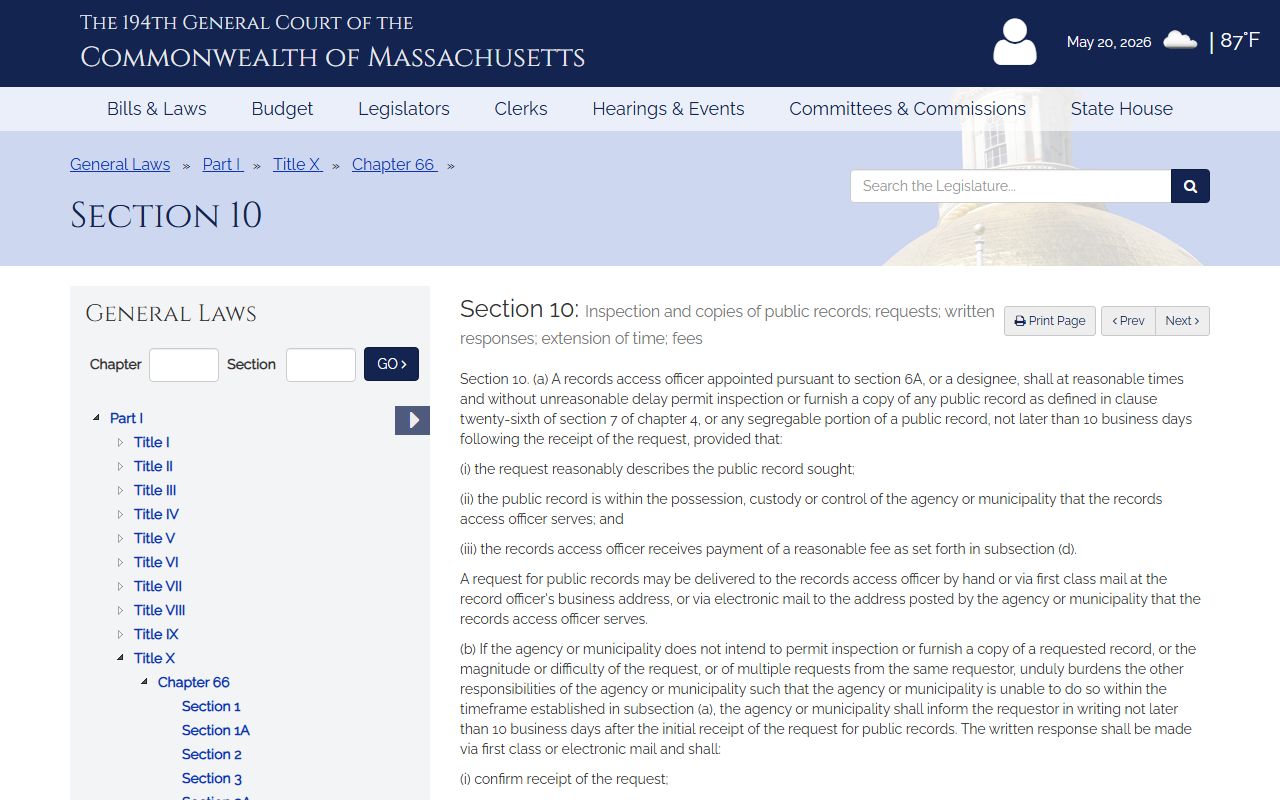
M.G.L. c. 66, §10 is the core statute that opens most government-held records to the public; reading the full text clarifies what the law requires and where its limits lie.
If you are unsure whether the records you need are court records, agency records, or Registry records, start by identifying who created or received the document and which government body currently holds it. That agency or office is where the request goes.
Note: criminal records held in the CORI system follow additional rules under M.G.L. c. 6, §§167-178 and are not fully accessible through a standard public-records request; see the arrest records page for more on CORI access.
How to File a Bristol County Public Records Request
Every Massachusetts state agency and municipality must designate at least one Records Access Officer (RAO). The RAO is the person you address your request to. The Secretary of the Commonwealth's guidance says requests may be made verbally, in person, or in writing, but if you later need to appeal a denial to the Supervisor of Records, you must have submitted a written request. Writing the request from the start protects your appeal rights and creates a clear record of what you asked for and when.
- Identify the right agency and RAO. Determine which Bristol County municipality or state agency holds the records you want. A request sent to the wrong office will not start the 10-business-day clock at the correct place. Most agencies post their RAO's contact information on their official website.
- Write a clear description of the records. You do not need to cite statutes or use legal language. Describe the documents by subject, date range, type, and any other details that will help the agency find them. Vague requests may slow the process or result in a narrower response than you intended.
- Address the request to the RAO by name or title. Include the agency's full mailing address, your own name, and your contact information so the agency can reach you with a response or questions. A return address or email is required for the agency to send a written response.
- Submit the request. Send by mail, email, or any other method the agency accepts. Keep a copy of everything you send and note the date you sent it. The 10-business-day response clock starts when the agency receives your request.
- Wait for the written response. The agency must respond in writing within 10 business days. The response must either provide the records, explain a specific exemption for any withheld material, or notify you that more time is needed due to the volume or complexity of the request and give a reason and a date by which it will respond.
- Pay any fees and receive the records. The agency may charge a reasonable fee for copies or for time spent locating records. If the fee seems too high or you believe the records were wrongly withheld, you have appeal options described in the next section.
Bristol County Public Records Request Form Fields
The Secretary of the Commonwealth provides a model public-records request template. You can adapt it or write your own letter using the same fields. The table below lists the fields from the Secretary's template and what to put in each one. None of these fields require personal information beyond what is necessary for the agency to respond; you are not required to explain your purpose or identify your employer.
| Field | Required | Notes |
|---|---|---|
| Date request mailed | Recommended | Establishes the timeline for the 10-business-day response window. |
| Records Access Officer name | Recommended | Address the request to the RAO for the specific agency or municipality. |
| Name of municipality or agency | Recommended | The government body that created or received the records you want. |
| Address / City / State / ZIP | Recommended | Full mailing address for the RAO so the written response reaches the right person. |
| Description of records requested | Yes | A reasonable, specific description. Include subject matter, date range, document type, and any reference numbers you have. |
| Requester name | Recommended | Needed so the agency can address its written response to you. |
| Contact information | Recommended | Mailing address, email address, or telephone number where the agency can reach you. |
Bristol County Response Times and Appeals
Massachusetts law gives agencies 10 business days to respond in writing to a public-records request. The response must either produce the records, deny the request with a specific exemption explanation, or notify you that additional time is needed and give a reason along with a date by which the agency will fully respond. An agency that fails to respond at all within 10 business days is treated as having denied the request, which opens the appeal path.
If an agency denies your request or fails to respond, M.G.L. c. 66, §10A gives you two options. First, you may appeal to the Supervisor of Records at the Secretary of the Commonwealth's office. The Supervisor reviews the denial and can order the agency to produce records. This step requires a written request on your end, which is one reason sending a written request from the start matters. Second, you may seek judicial review by filing a civil action in Superior Court. Both paths are available; the Supervisor of Records appeal tends to be faster and does not require legal counsel, though you may choose to consult an attorney for complex disputes.
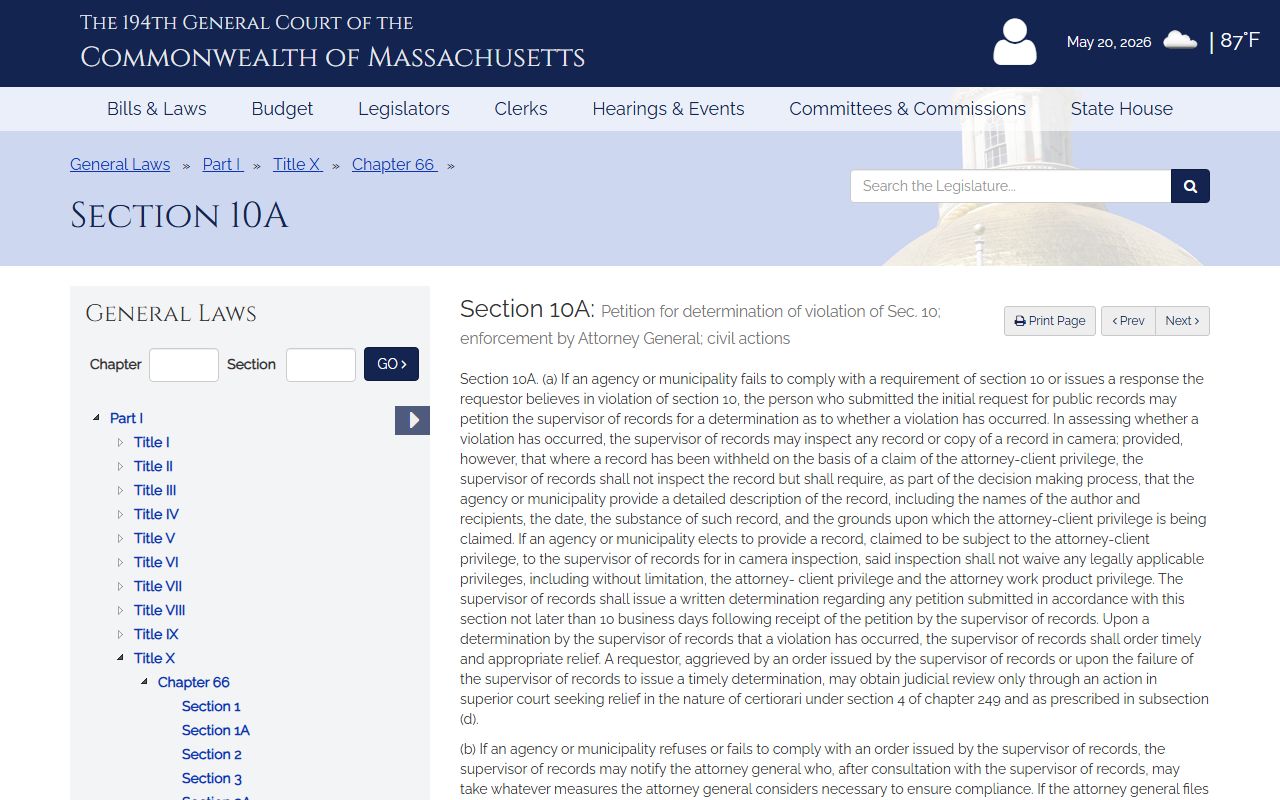
Section 10A lays out the precise steps for appealing a denied Bristol County public records request, including the Supervisor of Records route and the Superior Court civil action option.
Note: the appeal clock under §10A runs from the date of the denial or the end of the 10-business-day response period, so act promptly if you believe a denial was improper.
Exemptions That Keep Bristol County Records Private
Not every government record is open. M.G.L. c. 4, §7 clause 26 lists the categories an agency may use to withhold records. The exemptions are not automatic. An agency claiming one must show that the specific record falls within the category and that releasing it would cause the harm the exemption is meant to prevent. The burden is on the agency, not on you.
Common exemptions you may encounter when filing a Bristol County public records request include:
- Personal privacy. Information that would constitute a clearly unwarranted invasion of personal privacy, such as home addresses of private individuals, medical details, or identifying information where disclosure would cause harm disproportionate to the public interest.
- Investigatory materials. Records compiled for law enforcement purposes where release could interfere with an ongoing investigation, identify a confidential informant, endanger a witness, or deprive a defendant of a fair trial.
- Personnel and medical files. Employment records, performance evaluations, and medical information about government employees where disclosure would be unreasonably invasive.
- Security records. Plans, procedures, or technical information whose release could compromise the physical security of a facility or system.
- Trade secrets and proprietary information. Commercial or financial data submitted by businesses that would harm competitive interests if made public.
- Attorney-client communications. Privileged legal advice given to a government body by its counsel, unless the privilege has been waived.
Even if a record falls within an exemption, agencies sometimes have discretion to release it. If you believe an exemption is being applied too broadly, the appeal process described in the previous section is the right tool.
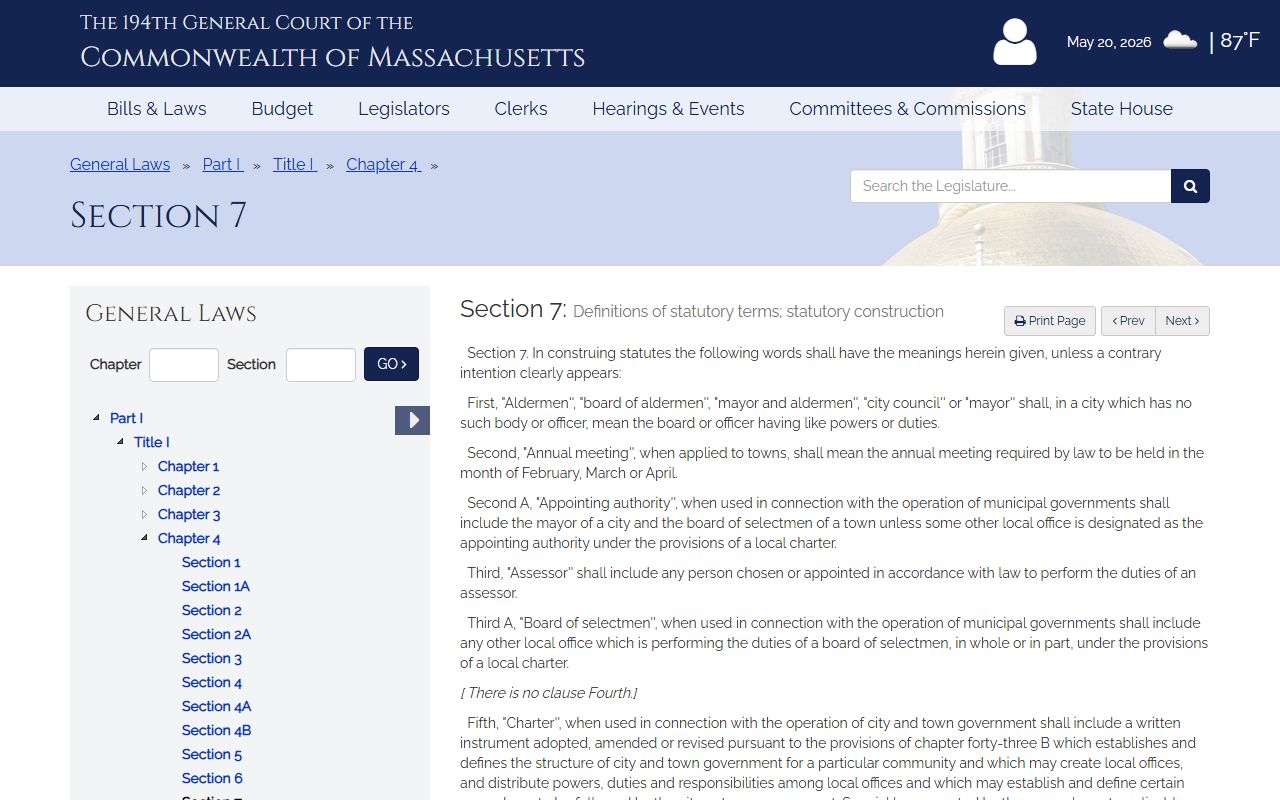
The full text of M.G.L. c. 4, §7 lists each exemption category and the conditions that apply; reading the statute helps you evaluate whether an agency's denial is well-founded.
Getting Official Court Copies in Bristol County
Court records are not obtained through a public-records-law request. Each Trial Court department in Bristol County maintains its own clerk or register office, and official copies come from that office. The MassCourts Electronic Case Access portal is a useful research tool, but Mass.gov is explicit: the online docket is not the official public record. For certified copies or paper versions of court documents, you go to the clerk or register office where the case was filed and bring the docket number, party names, case type, and filing year.
Bristol County has multiple court offices depending on case type and location. Superior Court records are held by the Clerk of Courts, Jennifer Sullivan, at the Taunton, Fall River, and New Bedford Superior Court locations. Criminal records sit in Taunton and Fall River; civil records sit in New Bedford. District Court records are held by Clerk-Magistrates at Attleboro, Fall River, New Bedford, and Taunton District Courts. Divorce, estate, guardianship, and family-law records are held by the Register's Office of the Bristol Probate and Family Court, Thomas C. Hoye, Jr., Register, with locations in Taunton, Fall River, and New Bedford. See the Clerk of Courts page for addresses, phones, and hours for each office.
The Uniform Rules on Public Access to Court Records, particularly Rule 5, govern remote access to court records. Under Rule 5, general public remote access does not currently include audio, audiovisual recordings, or PDFs of court documents. Basic docket information is available online, but for actual documents you typically need to visit or contact the clerk office. For divorce and other marriage and divorce records, the Probate and Family Court Register's offices are the starting point for certified copies. See the court records page for a full search walkthrough.
Note: the Bristol Probate and Family Court also offers a Virtual Registry by Zoom from 9:00 a.m. to 12:00 p.m. and 2:00 p.m. to 4:00 p.m. Monday through Friday for remote registry assistance, though official copies still require the Register's Office.
Land Records and the Northern Bristol Registry of Deeds
Property records for Bristol County are held by the Registry of Deeds, not by any court or municipal agency. The Northern Bristol County Registry of Deeds, located in Taunton at 11 Court Street, handles deeds, mortgages, homestead declarations, municipal lien certificates, UCC filings, and other land-related instruments. The Registry's fee page states that documents are public information and are available for viewing at the office or online at no charge. Recording hours are 8:00 a.m. to 4:00 p.m. Monday through Friday. Payment at the Registry is accepted by cash, check, or credit card; online recording payments are by credit card only. Separate checks are required for recording fees and excise fees.
The fee schedule below covers recording services at the Northern Bristol Registry of Deeds. These are land-record recording fees, not court-filing fees or public-records-request copy charges. They are included here because land records are among the most commonly requested public documents in Bristol County, and the fees are published officially by the Registry.
| Document Type | Recording Fee |
|---|---|
| Declaration of Homestead | $35 |
| Declaration of Trust | $255 |
| Deed | $155 |
| Mortgage | $205 |
| Mortgage Foreclosure Deed and Affidavit | $155 |
| Municipal Lien Certificate | $80 |
| UCC Documents | $75 |
| Federal Tax Liens and Related Documents | $5 |
Viewing documents at the Registry, whether in person or online through the Registry's portal, does not carry a fee. The recording fees above apply when you are filing or recording a new instrument, not when you are searching or copying an existing one. If you need a certified copy of a recorded document, contact the Registry directly about copy pricing, as that is separate from recording fees.